

Voltaire (1694-1778) and D’Holbach (1723-1789); 55 years of overlap-27 years for d’Holbach to grow as a philosopher=28 years of possible exchanges
Voltaire’s Beliefs:
The Candide is Voltaire’s most famous and most controversial work. Despite being suppressed, the fact that it was controversial made the populace want it more. In The Candide, Voltaire uses satire to expose how riding on optimism and organized religion is detrimental. Leibniz’s religious optimism claims that we live in the best of all worlds, and that even though we may experience bad things, the bad things are just a necessary evil to be able to be in the best world. Voltaire thinks this is not just wrong but offensive. The Candide uses the example of an earthquake that flattened Lisbon that there was so much pain and death that there is no way the world we live in is the best. The main arguments Voltaire makes is that “necessary evil” is actually pessimistic where everything bad that happens was going to come around eventually because it was “necessary.” Secondly is how if God were good then he would act and stop bad things from happening, but since he does not, Voltaire believes God is not benevolent nor omnipotent. This is where his idea of deism comes in that there must have been an entity to create our world and reality, but does not have the ability to interfere in our lives and do good, diverging from Christianity.
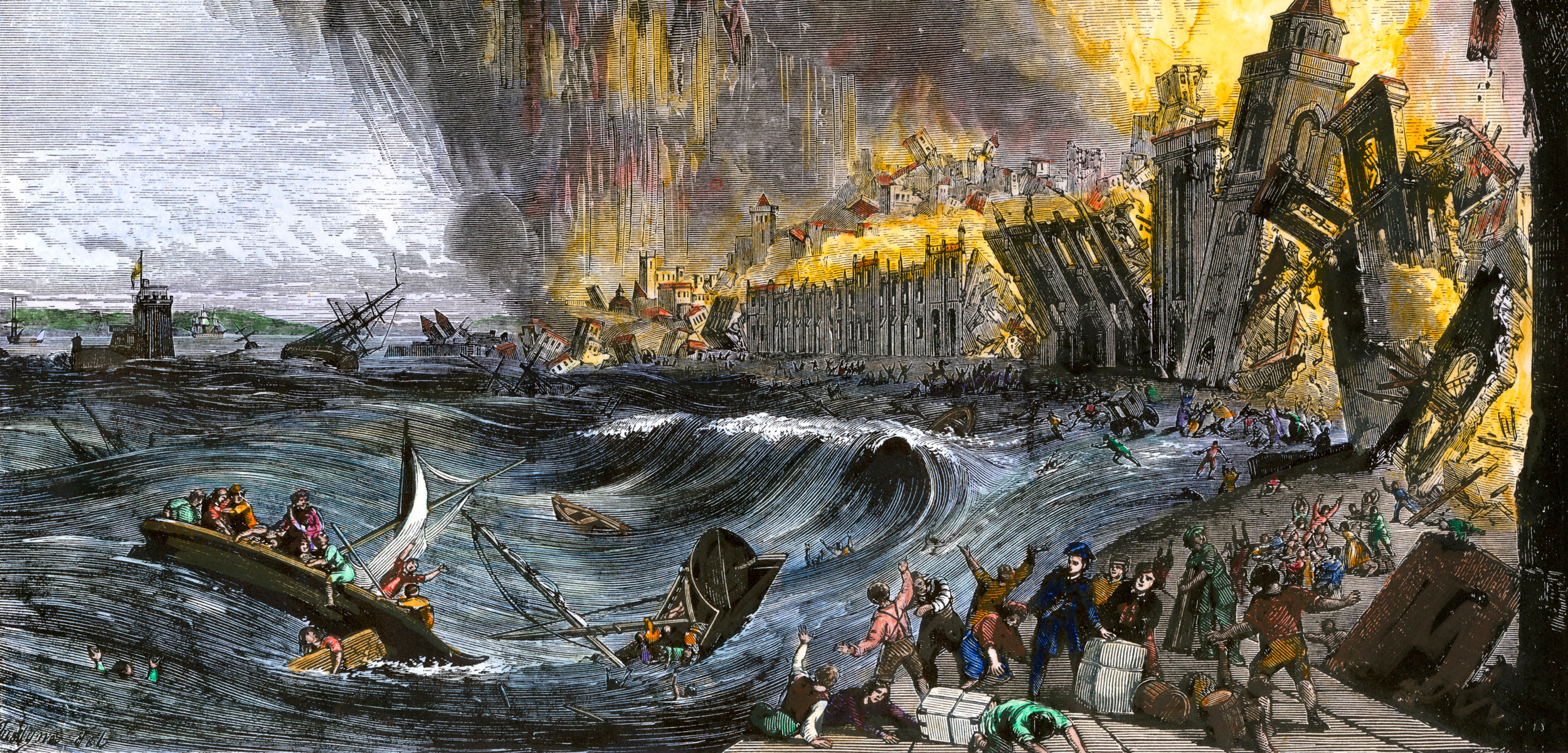
“If this is the best of possible worlds, what then are the others? Well, if I had been only whipped I could put up with it, for I experienced that among the Bulgarians; but oh, my dear Pangloss! thou greatest of philosophers, that I should have seen you hanged, without knowing for what! Oh, my dear Anabaptist, thou best of men, that thou should’st have been drowned in the very harbour!”
Candide VI
Voltaire’s Comments on Atheism
An important similarity between the two men is that they agreed that the existence of God depended on observation of the world. Where they diverged is the cause for nature’s order. Voltaire believed that evidence of God could be seen through nature (which is also why he denounces organized religions having “faith” which is a lack of evidence, believing in God should not require faith). Voltaire adopted the Newtonian view of God’s existence through nature. Nature has an inherent order that is universal to all things, and it could have only been made this way by a perfect being having it function so systematically and uniform. [1]
D’Holbach’s Counter
Nature’s Order: Quite similar to Hume, just because we perceive the world as orderly does not mean that nature in itself has that characteristic. We mistakenly attribute it as orderly because we see it act in ways that are similar to order in our lives. If someone only ever experiences earthquakes, they may say they are orderly while another person who experiences peace deems that as orderly, they conflict based on subjective information.
Order or Otherwise, There is no God: While D’Holbach concedes that while there is some kind of similarity between nature’s functions, God cannot be the explanation. Mysteriousness is rationalized through God, making it so that any real but undiscovered explanation is shrouded by false superstition. Having God be the reason for why things work the way they do pushes us further away from true understanding of the world.
Voltaire’s Comments on Government
The men’s views on government can be seen as being in direct conflict with one another. Voltaire agreed with D’Holbach that not having a separation of church and state is bad. More often than not it was exclusively the Catholic Church calling the shots. This caused problems for Voltaire because many of the heads within the church had their own agendas that were to benefit them and not aid the populace in any way. Voltaire thought that governments should not be operated on religious corruption but continue to be ruled by a constitutional monarchy. In this way, the societal hierarchy would be run by the non-corrupt and educated peoples.
Constitutional Monarchy: Ruler of one king but has a court of philosophers to guide decisions and is restricted by a constitution.
D’Holbach’s Counter
He actually agrees that a constitutional monarchy is probably the best, but that there should be a parliament instead of just a group of advisors. This would make it so that if either the monarch or the general population fall to tyranny there would be a middleman of sorts to enact order. D’Holbach also places more emphasis on a social contract, rights, and the importance of welfare in a society, as explained in his novel Ethocracy. Both Voltaire and D’Holbach were living under the French Absolute Monarchy with rampant hunger and poverty, which explains such beliefs being had, but unfortunately they passed before the succession of the French Revolution in 1789.
They Had an Interesting Relationship..
Throughout D’Holbach’s works, most importantly The System of Nature and Good Sense, readers found passages that were similar or even verbatim of Voltaire’s arguments. However, there is not an absolute explanation for why the baron’s writing mirrors Voltaire’s so often, but there are 3 most plausible theories:
D’holbach loved Voltaire: “While limited, d’Holbach’s comments on Voltaire’s works are unfailingly positive. In chapter 9 of the Éthocratie , the baron singles out Voltaire and Saint – Lambert as two very rare examples of commendable poets, further stating that poetry is only worthy of esteem if it is “philosophical, instructive and ethical” ( philosophique, instructive et morale ).” [2]
D’holbach needed an alias to spread his word: “It appears from what has just been argued that, at times, d’Holbach may have consciously attempted to fool his readers into attributing his works to Voltaire. And indeed, further evidence for this can be provided. It is quite telling, for example, that the “Préface” to the Lettres à Eugénie may attempt to present the latter text as having been written in the 1730s by someone belonging to the “ É cole du Temple ou de Sceaux”, and who had been in friendly terms with both Charles – Auguste de la Fare and Guillaume Amfrye de Chaulieu. Equally interesting is the fact that, in the 18th century, some of d’Holbach’s works were occasionally printed (or re – printed) alongside Voltaire’s.” [3]
D’holbach wanted to manipulate Voltaire: “By alluding to the same sources to which Voltaire would normally refer and by re – employing Voltaire’s images, phrases and lines of reasoning in the con – text of his own atheistic and deterministic texts, d’Holbach – and here we get to our second point – may have also tried to attract and retain Voltaire’s attention, thereby winning him over to his atheistic and deterministic cause. And indeed, to a certain extent, d’Holbach’s strategy may have proved successful. Originally a strong advocate of moral freedom (suffice it to think of his correspondence with Frederick II or the Traité de métaphysique ), towards the end of his life Voltaire became more of a determinist.48 As argued by Christophe Paillard, where Voltaire’s endorsement of determinism appears most clearly is in the Lettres de Memmius à Cicéron of 1771.” [4]
Voltaire hated D’Holbach’s ideas and didn’t want to be associated with him at all. D’holbach’s System of Nature was said to be in direct conflict with Voltaire’s beliefs. As he got older, he was scared about the future of the enlightenment movement that it was being left in the hands of an unruly atheist, similar to the threat of Spinoza’s ideas on society. He wrote to D’Holbach that since he cannot prove that Materialism is correct, then he has no grounds to say that God isn’t real. In doing this Voltaire realized he could not truly explain the existence of God either. Meaning, neither of them could be 100% right..[1]
The Candide https://www.gutenberg.org/files/19942/19942-h/19942-h.htm
[1] https://sveinbjorn.org/voltaire_d_holbach_and_the_design_argument
[2] The Great Protector of Wits : Baron d’Holbach and His Time, edited by Laura Nicolì, BRILL, 2022. ProQuest Ebook Central, http://ebookcentral.proquest.com/lib/rochester/detail.action?docID=7026234.
Created from rochester on 2025-11-15 16:33:47.
[3] The Great Protector of Wits : Baron d’Holbach and His Time, edited by Laura Nicolì, BRILL, 2022. ProQuest Ebook Central, http://ebookcentral.proquest.com/lib/rochester/detail.action?docID=7026234.
Created from rochester on 2025-11-15 16:38:31.
[4] The Great Protector of Wits : Baron d’Holbach and His Time, edited by Laura Nicolì, BRILL, 2022. ProQuest Ebook Central, http://ebookcentral.proquest.com/lib/rochester/detail.action?docID=7026234.
Created from rochester on 2025-11-15 16:45:56.