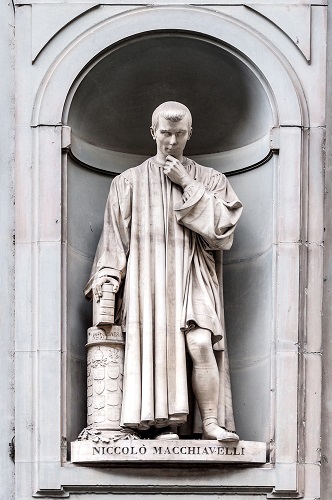
Balance & Adaptability: Niccolò Machiavelli’s Ideal Prince
Niccolò Machiavelli’s ideal Prince is a dynamic one. His philosophy is based on different historical examples of Princes, both great and abysmal, and is highly dependent on the situation a leader is in. His actions may change based on whether his principality is new or established, whether he gained power through the nobles or commoners, or even the landscape of his territory. There, therefore, is not an exact description of an “ideal” Prince, but there are basic principles that underlie all of the advice that Machiavelli gives. Machiavelli’s ideal Prince is one that prioritizes the maintenance and strengthening of his state above all else, ensuring that it will continue to prosper even after his death. How a Prince achieves that varies based on his situation, therefore it is necessary for him to be flexible in his virtues and morals, as well as knowledgeable about how to best navigate the external and internal affairs of his state.
Machiavelli, in contrast to many political philosophers at and before his time, did not believe that it was necessary for the ideal ruler to be wholly virtuous. Machiavelli was adamant about the imperfection, or even inherent cruelty, of human nature, criticizing political philosophers who imagined a truly ideal Prince that only existed in theory and could not be found in reality. He thought that it would be good for a ruler to be virtuous, however it would be sufficient for him to just “avoid the reproach of those vices which would lose him his state” (Machiavelli 84). Machiavelli’s Prince prioritizes the state above all, therefore the vices he does and does not indulge in are dependent on how they would affect his principality. Similarly, his ideal Prince should be able to, if the situation calls for it, use a vice in his favor. Machiavelli believes that war and conflict are inevitable, therefore “it is necessary for a prince wishing to hold his own to know how to do wrong” (Machiavelli 84) because underhanded tactics will eventually be needed. While Machiavelli deprioritizes the virtuous nature of his Prince, he does not completely disregard it. He claims we should only “make use of it [vice] or not according to necessity” (Machiavelli 84); emphasizing that only dire situations require immoral actions. Machiavelli also makes a distinction between men who gained power through talent and “those who have obtained a principality by wickedness” (Machiavelli 55). He describes Agathocles, the Sicilian, who became the King of Syracuse by deceiving his allies and killing his fellow citizens, and claims that he will never achieve “glory” (Machiavelli 56). Machiavelli concedes that he did build an empire, but his cruelty does “not permit him to be celebrated among the most excellent men” (Machiavelli 56). Machiavelli’s ideal Prince is well versed in both vice and virtue, and uses vice sparingly when maintaining his state requires it.


Machiavelli argues that, in order to properly manage external affairs, a Prince should familiarize himself with the art of war and build a capable army. Machiavelli claims that “a prince ought to have no other aim or thought, nor select anything else for his study, than war and its rules and discipline” (Machiavelli 81) because when his state is threatened, the Prince will be the one tasked with defending it. When describing how a Prince should familiarize himself with the art of war, he claims rulers should read histories and “study there the actions of illustrious men” (Machiavelli 82), so that he can learn from both their victories and defeats. He uses Alexander the Great as an example, highlighting how he “imitated Achilles, Caesar Alexander, Scipio Cyrus” (Machiavelli 82) when building his empire. Machiavelli also advises that a Prince should assess his territory, taking stock of different landforms and features, to better plan which places would be advantageous to hold during conflict. Machiavelli suggests this not so only the Prince is familiar with his own land, but also so that he can be familiar with others. He claims that “the hills, valleys, and plains, and rivers and marshes that are, for instance, in Tuscany, have a certain resemblance to those of other countries, so that with a knowledge of the aspect of one country one can easily arrive at a knowledge of others” (Machiavelli 81). Machiavelli also warns against being complacent during times of peace and leaving his state vulnerable. A Prince should make use of uneventful periods to stockpile resources, study military strategies, and strengthen his army. Machiavelli’s ideal Prince is constantly refining his knowledge of military strategies and preparing for war.
Machiavelli’s ideal Prince manages his internal affairs by enforcing order while still gaining the goodwill of his people. Machiavelli claims that all states, regardless of their circumstances, are reliant on good arms. He believes that there cannot be “good laws where the state is not well armed” (Machiavelli 71) because authority is based on the means of which it is enforced. If there are no consequences to disobeying a Prince or his laws, then there is no incentive to follow him. While this may seem cruel, Machiavelli considers it cruel to have “too much mercy, [and] allow disorders to arise” (Machiavelli 89). This will lead to “murders or robberies” that will “injure the whole people” (Machiavelli 89), in comparison to stricter rules that prevent these incidents from happening in the first place. While this may imply that Machiavelli’s Prince would seem cruel, Machiavelli urges his readers to avoid earning the hatred of his citizens at all costs. Citizens that despise their Prince lead to internal instability, unrest, and eventually rebellion. So that a Prince has no reason to fear internal enemies, it is important to keep his citizens content. Machiavelli emphasizes that his methods of ensuring order are not cruel and will not anger citizens as long as a Prince “neither [touched] their [citizens] property nor their honor” (Machiavelli 96). Similarly, it is also important to consider the different roles citizens have in a principality and how to keep all of them happy, for example a Prince has to take “care not to drive the nobles to desperation, and to keep the [common] people satisfied and contented” (Machiavelli 98). Machiavelli’s ideal Prince maintains order but does not offend his citizens, he is feared to ensure his authority but not hated.
Machiavelli prioritizes adaptability and balance above all else. His Prince can be virtuous or wicked, he can cater to his citizens or to his laws, and he is capable of fighting any battle his state needs him to. He, unlike the Princes of many other philosophers, does not need to fully encompass all of these values. Machiavelli believes perfection is unrealistic and does not want to create a mythical ruler. Machiavelli’s ideal Prince, however, strives to achieve them all to the best of his human capabilities.
“Because the Romans did in these instances what all prudent princes ought to do, who have to regard not only present troubles, but also future ones, for which they must prepare with every energy, because, when foreseen, it is easy to remedy them; but if you wait until they approach, the medicine is no longer in time because the malady has become incurable” (Machiavelli 34)
“Hence it is necessary for a prince wishing to hold his own to know how to do wrong, and to make use of it or not according to necessity” (Machiavelli 84)
Another reason Machiavelli valued military prowess was because of the internal power dynamics between a Prince and his soldiers. He claimed that being unarmed "causes you to be despised" (81) because the powerful have no reason to defer to the weak. Therefore, if soldiers see that their Prince is not as capable as they are, then they will start to resent that they have to defer to him, and eventually they will just resent him.
“He ought never, therefore, to have out of his thoughts this subject of war, and in peace he should addict himself more to its exercise than in war; this he can do in two ways, the one by action, the other by study” (Machiavelli 81)
Machiavelli's claim that "good arms" are necessary for order is derived out of his belief that men are inherently evil and chaotic. He believes there is no other reason for men to listen besides force.
Glossary
- Authority: the right to give orders/require obedience. This goes hand-in-hand with power, because by Machiavelli’s definition, authority does not exist without the power to enforce it.
- Good arms: A strong, capable military that is ready at all times and able to enforce laws.
- Prince: Someone who rules over a state or Principality, either gaining that position through hereditary or forceful means.
- Principality: A kingdom, empire, or country ruled by a Prince; a Prince’s territory.
- State: A general country, territory, or empire ruled by a leader.
- Virtues: A set of upstanding principles/ morals including but not limited to: generous, compassionate, faithful, brave, chaste, sincere, and religious.
“One is reputed generous, one rapacious; one cruel, one compassionate; one faithless, another faithful; one effeminate and cowardly, another bold and brave; one affable, another haughty; one lascivious, another chaste; one sincere, another cunning; one hard, another easy; one grave, another frivolous; one religious, another unbelieving, and the like” (Machiavelli 84)